
On June 3, 2026, something quietly powerful happened. A group of teachers from Brighter Tomorrow packed into a van and drove toward a very different kind of classroom – one with soft mats, wooden puzzles, and children who chose their own work.
The idea had come up weeks earlier, during a Brighter Tomorrow team meeting. The teachers were curious and wanted to see with their own eyes how children from more privileged backgrounds were being taught. Not to compare what Brighter Tomorrow lacked, but to learn what we could borrow.
Wajid and Basir coordinated the visit with Qari Hussain Badshah, owner of Brighter Tomorrow’s partner school, who shares our belief that quality education shouldn’t be limited by geography or income.
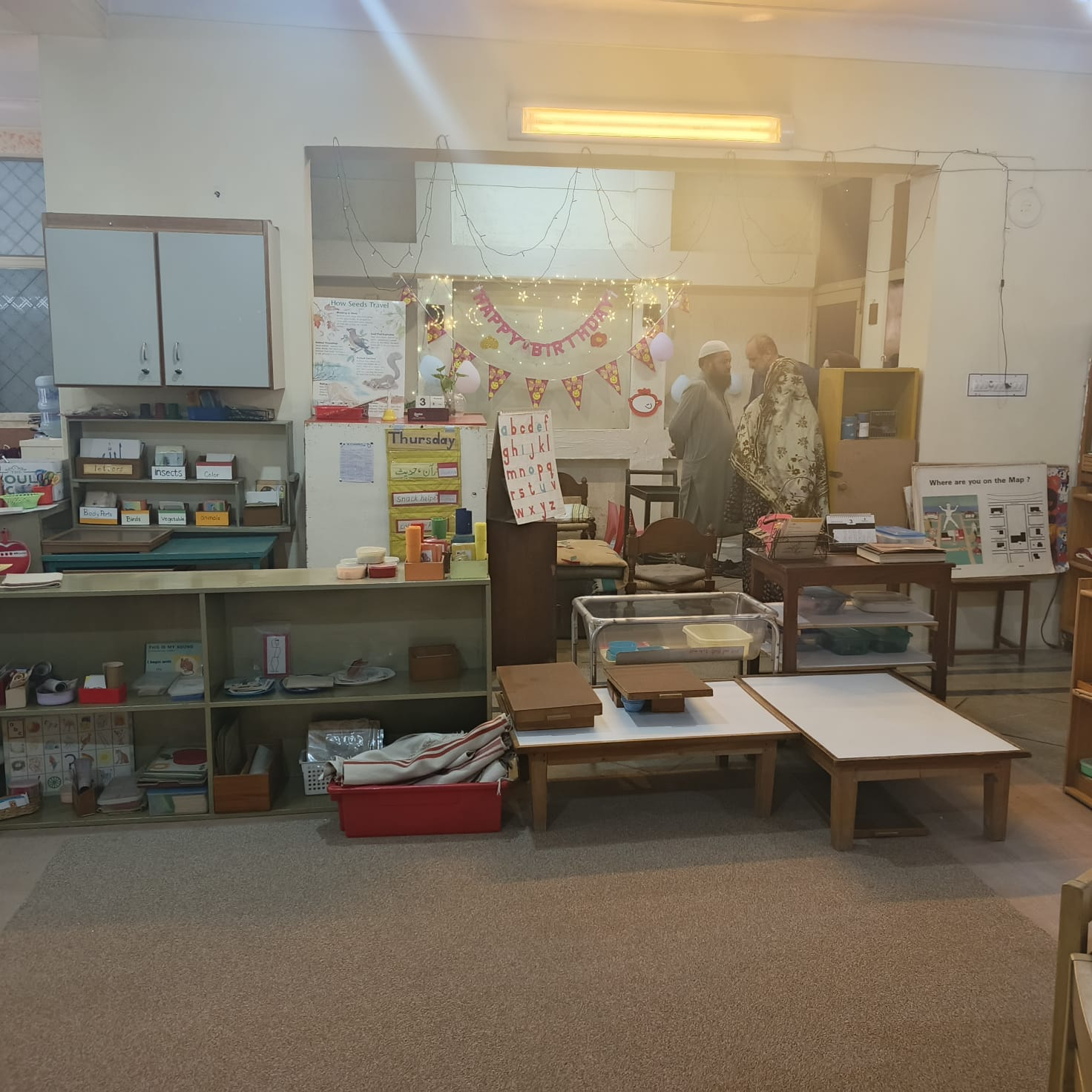
The moment our teachers walked in, the contrast was hard to ignore.
At the Montessori school, children moved with quiet purpose between shelves of learning materials. Every corner of the room seemed designed to invite curiosity – labeled trays, child-sized furniture, natural light. Back in the village, Brighter Tomorrow’s classrooms work with a fraction of the resources, and it showed. The gap wasn’t just in paint and furniture. It was in the sheer amount of thought that had gone into every square foot of the room.
For the visiting teachers, seeing that gap up close wasn’t discouraging – it was clarifying. It gave shape to what they’d always sensed but rarely had the words for: that a child’s environment speaks to them just as loudly as a lesson does.
For generations, education in Pakistan has leaned on repetition and memorization, children reciting answers they don’t fully understand, rewarded for accuracy rather than curiosity. It gets results on a test. It does very little for a child’s ability to think.
That’s exactly where the Montessori model pulled the visiting teachers in. There was no child being asked to repeat something they didn’t understand. Instead, children were touching, sorting, building, and figuring things out at their own pace, and retaining far more because of it. Ms. Shamim Akbar, owner and master trainer of the Montessori school, walked the group through the philosophy behind it: learning that starts with the child’s own hands and curiosity sticks in a way that copied-down answers never will.
The visit’s centerpiece was a session led by Ms. Shamim Akbar herself – the owner of the institution and a Montessori Master Trainer with specialized training from the United States, the United Kingdom, and Australia. She didn’t just describe Montessori theory; she showed how she had adapted it, piece by piece, to fit local culture and context rather than importing it wholesale.
She spoke about child development, classroom management, and early learning, but what stayed with the Brighter Tomorrow teachers most was something simpler. When they described their own methods – active listening, pausing after a question to let a child actually think before answering, Ms. Akbar didn’t just nod politely. She told them, plainly, that what they were already doing was good practice, and that they were capable of bringing real Montessori principles into their own classroom, even without the shelves and the imported materials.
For teachers not used to external recognition, hearing that from a Master Trainer meant a lot.
The teachers didn’t just leave inspired, they left with a plan.
One of the first things they noticed at the Montessori school was how much emphasis was placed on hygiene: handwashing routines, clean personal habits, children learning to care for themselves and their space as part of daily practice. Back at Brighter Tomorrow, the teachers decided this was something they could act on immediately, no budget required. They’ve since begun teaching the children basic hygiene practices modeled on what they observed – handwashing, cleanliness, and self-care habits – folding it naturally into the school day.
It’s a small shift on paper. In a village classroom, it’s the beginning of a bigger one.
This visit was a reminder of something Brighter Tomorrow believes deeply: quality early education isn’t only about resources. It’s about how well teachers understand the children in front of them, and how willing they are to keep learning themselves.
The teachers came back animated, already talking through which ideas they could adapt and which would need reworking for their own classroom. That energy – a teacher choosing to grow – is often the most under-appreciated ingredient in a child’s education.
Our sincere thanks go to Ms. Shamim Akbar and her team for their generosity, openness, and willingness to share what they’ve spent years building. What they offered wasn’t just a tour of a school. It was a validation that good teaching can look different in different settings — and that Brighter Tomorrow’s teachers are already doing meaningful work.